
It usually starts with a phone call late at night.
Your mother mentions, almost in passing, that your father fell last week. Or your aunt tells you your parents have not been eating properly. Or you notice, on a video call, that the house looks different. Quieter. Smaller somehow.
And then the question arrives, the one you have been pushing away for months, maybe years: Should I just go back?
If you are an NRI wrestling with this, you are not alone. Millions of Indian families are navigating exactly this tension right now. One generation built lives abroad. The other grew older at home. And somewhere in between, the question of who is responsible for whom, and from where, became the hardest one in the family.
This guide will not tell you what to do. But it will help you see the full picture, understand what is really driving the question, and introduce a third option that many NRI families have found changes everything.
What Drives the Feeling That You Need to Go Back
The urge to return is rarely about logic. It is about love, and fear, and a culture that teaches us that caring for parents is not optional. It is who we are.
There is the guilt of being thousands of kilometres away when something goes wrong. The helplessness of relying on neighbours, relatives, or hired help to be your eyes and hands. The quiet grief of watching your parents age through a phone screen, catching the small changes, the slower movements, the pauses before they answer, and not being able to do anything about it.
There is also often pressure. From family. From the community. From the unspoken comparisons with siblings or cousins who stayed closer. And from a voice inside you that says: a good son or daughter would be there.
It is worth naming all of this clearly, because decisions made primarily to escape guilt are rarely the right ones. Guilt is a signal worth listening to. But it is not a compass. Before you can decide what to do, you need to separate what you feel from what your parents actually need. Those two things are related, but they are not the same.
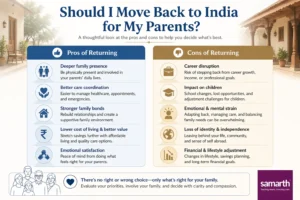
The Real Cost of Returning
Before making any decision, it is worth being honest about what returning to India actually involves. Not the version where everything works out, but the full picture.
Your career and financial security. Depending on your field, returning may mean starting over professionally. Years of seniority, pension contributions, retirement savings, and foreign income do not always transfer. The financial impact can affect not just your present, but your own family’s long-term security. This matters more than it is comfortable to admit.
Your children’s lives. If you have children in school abroad, uprooting them has real consequences. Social, academic, and emotional. Friendships, routines, and educational trajectories take years to rebuild. It is not an insurmountable challenge, but it deserves honest weight in the decision.
Your relationship with your parents. This one surprises many people. Moving back out of obligation, not genuine choice, can quietly reshape the dynamic between you and your parents. The care you provide can start to feel like a sacrifice, and sacrifice, over time, breeds resentment. Not always. Not inevitably. But the risk is real and worth acknowledging.
Your own identity and mental health. You have built a life abroad. Friendships, routines, a sense of self that belongs to that place. Dismantling it is not just a practical event. It is an identity shift. Many returning NRIs describe a disorienting in-between: no longer fully at home in India, no longer fully belonging to the life they left. That adjustment takes longer than people expect, and it has a cost.
None of these are arguments against returning. For some families, returning is genuinely the right answer. But the decision deserves to be made with eyes open, not just with the part of you that wants to stop feeling guilty.
The Real Cost of Not Returning
Staying abroad has its own weight, and it is worth noting that honestly too.
There is the fear that something will happen and you will not be there. Not an abstract fear, but a specific one. A fall in the night. A health crisis that escalates because no one caught it early. A parent who is struggling but will not say so because they do not want to worry you.
There is also the slow accumulation of ordinary absence. A birthday celebrated over a video call. A health scare managed through WhatsApp messages to relatives. An ordinary Tuesday afternoon with your father that you will never get back.
And there is the practical reality that distance creates genuine gaps in care. A monthly bank transfer solves some problems. It does not solve medication management, or doctor’s appointments, or the fact that your mother needs someone who actually knows her to notice when she is not quite herself.
The cost of not returning is not just the guilt you carry. It can be your parents’ safety, their sense of being truly looked after, and their quality of life in a period when those things matter enormously.
This is not meant to increase your guilt. It is meant to help you take the real risks seriously, so that whatever you decide, you are deciding with honesty about what is actually at stake.
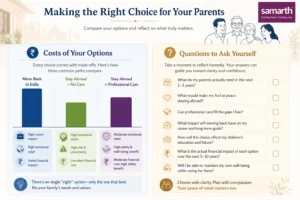
A Third Option: Professional Care as a Genuine Substitute
Most NRIs frame this as a binary: go back, or stay and carry the weight of having chosen not to.
But there is a third path, and it is one that more Indian families are finding is a genuine answer rather than a compromise. That path is professional elder care, structured and consistent enough to function as a real extension of you on the ground.
Not a neighbour who checks in when they can. Not domestic help who manages the household but has no training to manage health. A proper care ecosystem built around your parents’ specific needs, with trained caregivers, medical coordination, and someone accountable at every step.
The distinction matters. The worry that keeps most NRIs up at night is not really about physical distance. It is about reliability. About whether someone is actually watching for the things that matter, proactively rather than reactively, consistently rather than occasionally. Professional care, when it is done well, addresses that worry directly.
This is not about outsourcing love. Your parents know you love them. What they need, alongside that love, is practical support that their bodies and daily lives are genuinely requiring. Providing that through professional care, while staying present in their lives emotionally and staying connected across the distance, is a legitimate and increasingly common way for NRI families to make this work.
For many families, discovering this option has changed the nature of the decision entirely. It has allowed them to ask: not should I go back, but what does my family actually need, and what is the best way to provide it?
What Good Care in India Looks Like Today
Elder care in India has changed significantly over the past decade. The best providers now offer a genuinely comprehensive model, not supplementary help but structured, professional support.
Regular in-home visits from trained caregivers. Scheduled, consistent support from professionals who know your parents, understand their health history, and build real relationships with them over time. Not strangers showing up on rotation, but familiar faces who become part of the household rhythm.
Medical coordination and health monitoring. Medication management, accompaniment to doctor’s appointments, proactive health tracking, and early flagging of warning signs before they become emergencies. This is the gap that most NRIs worry about most, and a good care provider fills it directly.
Emergency response systems. Dedicated emergency contacts, clear protocols, and backup plans that do not depend on a neighbour being available or a relative picking up the phone. When something goes wrong at 2 am, there is a system, not a scramble.
Companionship and emotional well-being. Loneliness is one of the most significant and underappreciated health risks for ageing adults. Quality care providers treat companionship as a core part of the service, not an optional extra.
Regular, proactive communication with the family abroad. You receive updates as a matter of course, not only when something is wrong. You stay informed. You remain genuinely part of your parents’ care, even from thousands of kilometres away.
This is not a care as a stopgap. It is care as a genuine infrastructure around your parents’ lives.
Questions to Ask Yourself Before Deciding
Before you make any decision, to return, to stay, or to explore professional care, it is worth sitting with these questions honestly.
What do your parents actually need right now, and what are they likely to need in the next two to three years? Are you considering returning because it is genuinely the right answer for your whole family, or because it is the option that quiets the guilt most quickly? Have you asked your parents what they want, not the answer they give to avoid worrying you, but what they would genuinely choose if they felt free to say? What would it actually take for you to feel at peace staying abroad, not just managing the guilt, but genuinely confident that your parents are well and safe? And if professional care could reliably provide the support and presence you are most worried about, would staying abroad feel like a different kind of choice?
There are no universally correct answers. The right decision depends on your family, your parents’ specific needs, your circumstances, and what you can honestly sustain. But whatever you decide, the decision is better made with clarity than with panic, and with an honest picture of all your options rather than just two.
See If Professional Care Could Be Your Answer
If you are an NRI trying to figure out what your parents actually need and whether you need to be there to provide it, Samarth can help you think it through.
Samarth works with NRI families across the world to build care arrangements around ageing parents in India. Not generic packages, but actual assessments of what your parents need, what support is already in place, and what gaps need to be filled to give them, and you, genuine peace of mind.
For children living abroad, the conversation often starts not with a care plan but with a question: What would it take for me to feel truly at peace about my parents from here? Not just less guilty. Actually confident that they are being looked after.
That is the question Samarth is designed to help you answer. Reach out to the team today, not to be sold a service, but to have an honest conversation about what your family needs and what is possible.
Being Far Away Does Not Mean Being Absent
Loving your parents from abroad does not make you a lesser child. It makes you a person doing something genuinely hard, trying to honour a commitment to your family while also living the life you built, often the life they encouraged you to build.
The guilt you carry is a sign of how much you care. But guilt alone does not keep your parents safe, and the fact that you are far away does not mean they cannot be genuinely, reliably looked after.
Your parents need to feel safe. They need to feel cared for. They need to know that someone is paying attention, that help is there when they need it, and that they have not been forgotten.
Whether you are the one who provides that in person, or whether you build the right support around them so they have it regardless, what matters is that they have it.
That is what this decision is really about.