
You have been thinking about this conversation for months. Maybe longer. You have rehearsed it on long flights home, typed it out in unsent messages, and brought it up carefully once before, only to watch your parent shut it down before you could finish your sentence.
“I don’t need anyone.” “We are managing fine.” “Don’t waste your money.” “What will people say?”
And so the conversation ends before it begins. You go back to worrying from a distance. They go back to managing alone. And the gap between what you can see is needed and what they are willing to accept quietly grows.
If this sounds familiar, you are not alone. For most NRI families, this is not a practical conversation. It is an emotional one. And it requires a very different approach than most people try.
Why Indian Parents Resist Help
Understanding why your parent is saying no is the first step to finding a way through.
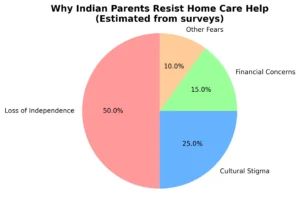
For most elderly Indians of this generation, accepting outside help feels like a loss of something fundamental. They built their lives on self-sufficiency. They raised families, managed homes, and navigated hardship without asking for assistance. The idea of a stranger coming into their home to help with daily tasks can feel like a public admission of decline, and that is deeply uncomfortable.
There is also the cultural dimension. In India, care has traditionally been a family responsibility. Parents cared for their own parents. They expect their children to do the same. When a caregiver is proposed instead, it can feel like a substitution rather than a supplement, as though you are outsourcing what should be a personal obligation.
And underneath all of it, there is often fear. Fear of losing independence. Fear of what the need for help means about their health. Fear of becoming a burden, even as they refuse the very help that would ease that burden.
None of this resistance is irrational. It comes from a lifetime of values, pride, and love. The conversation will only move forward when you acknowledge that, rather than argue against it.
The Wrong Way to Bring It Up
Most well-intentioned conversations about care fail not because of the message, but because of the approach. Here are the patterns that almost always backfire.
Leading with fear does not work. Saying “What if something happens to you and no one is there?” immediately puts your parent on the defensive. It frames the conversation around their vulnerability rather than your love for them.
Coming with a plan already made does not work either. If you arrive having researched caregivers, compared services, and already decided what is needed, your parent will feel managed rather than consulted. The decision has been made without them, and now they are simply being informed. Most people, of any age, resist that.
Involving too many people at once rarely helps. A family meeting where multiple children, relatives, and perhaps a doctor all weigh in on what a parent needs can feel overwhelming and humiliating. It signals that a group of people has been discussing their decline behind their backs.
And making it a single, high-stakes conversation rarely succeeds. When the expectation is that everything gets resolved in one sitting, the pressure on both sides becomes too great. The parent feels cornered. The child feels frustrated. The conversation ends badly, and the subject becomes harder to raise again.
How to Open the Conversation the Right Way
The goal of the first conversation is not to reach a decision. It is simple to open a door.
Start by asking rather than telling. Before you say anything about care, ask your parent how they’ve been feeling lately. Ask what parts of the day feel tiring. Ask if there is anything they wish they had more help with. Let them speak first. What they say will tell you more than any assessment could, and it shifts the dynamic from you presenting a solution to both of you exploring a reality together.
Here is a way to open that conversation:
“Amma, I have been thinking a lot about you lately. Not because anything is wrong, but because I love you and I want to make sure your days feel comfortable. Can I ask, is there anything at home that has been feeling harder than it used to?”
Then listen. Do not jump to solutions. Do not steer toward the conclusion you have already reached. Just listen, and let them feel heard before anything else happens.
If they resist or deflect, do not push. Simply say: “That’s okay. I just wanted to ask. We don’t need to decide anything today.”
That ending matters. It removes the pressure and signals that this is a conversation, not a negotiation with a deadline

Reframing Care as Love, Not as a Burden
One of the most powerful shifts you can make is in how care itself is described. The word caregiver carries clinical weight. Words like help, support, and assistance often trigger the same resistance. What lands differently is language that connects care to love, to comfort, and to your own peace of mind.
Try this reframe:
Instead of “You need someone to help you,” try “I want to know that someone is with you because it helps me feel closer to you when I cannot be there myself.”
Instead of “We are worried about you managing alone,” try “We just want your days to feel easier, not because something is wrong, but because you deserve that.”
This is not manipulation. It is an honest reframing of something that is genuinely true. You do want peace of mind. You do want their days to be easier. Saying so puts the conversation in its rightful place, as an act of love rather than a response to decline.
Involve Them in Every Choice
Resistance often comes from feeling that something is being done to a parent rather than with them. The antidote is genuine involvement at every step.
Let them choose the timing of any support. Let them decide which tasks they want help with and which they want to manage on their own. Let them meet a potential caregiver and give you their honest reaction before anything is decided. Let them set the boundaries of what help looks like in their own home.
When a parent feels that their preferences are genuinely shaping the outcome, the conversation changes from a negotiation to a collaboration. They are no longer being managed. They are making a decision. And people who make decisions are far more likely to honour them.
The Trial Run Approach
For parents who are not ready to commit to regular care, a trial period is often the most effective bridge.
The framing is simple: “Let’s just try it for two weeks. If it doesn’t feel right, we stop. No pressure, no obligation.”
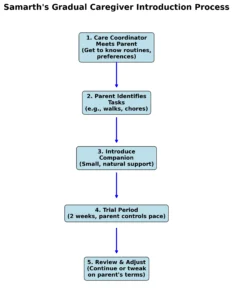
A trial removes the permanence that makes the idea feel so heavy. It is not a life change. It is an experiment. And most parents, when given the option to opt out at any point, find the barrier to saying yes much lower.
What usually happens during a trial is that the caregiver and the parent begin to build a natural rapport. The parent experiences the practical relief of having help. A familiar face and a comfortable routine replace the fear of the unknown. By the end of the trial, the question is rarely whether to continue. It is usually about what works best going forward.
How Samarth Introduces Caregivers Gradually
At Samarth, we understand that the relationship between an elderly parent and a caregiver is built on trust, and trust takes time. That is why we never begin with a full care arrangement. We begin with a conversation.
Our care coordinators meet with your parent first, not to assess or to plan, but to get to know them. Their routines, their preferences, their history, the things that matter to them. This first meeting is deliberately unhurried and has no agenda beyond connection.
From there, we introduce support in small, natural increments. A companion who accompanies them for a walk. Someone who helps with a specific task they have identified as tiring. Presence that grows organically into care, at a pace your parent controls.
For NRI children, this means you do not have to be the one to navigate the difficult middle ground between what your parent wants and what they need. We hold that space with patience, warmth, and deep familiarity with how Indian elders think and feel about these transitions.
Your Parents Deserve to Feel Chosen, Not Managed
The conversation about care is hard because it touches everything that matters. Independence, dignity, love, fear, and the complicated feelings that live between parents and the children who grew up and moved far away.
But this conversation, done well, does not have to feel like a confrontation. It can feel like exactly what it is: a child who loves their parent, trying to make sure that love shows up in their daily life, even across the distance.
Your parents spent decades making sure you felt cared for. This is your chance to return that, not by taking over, but by making sure they are held well, in their own home, on their own terms.
Not sure where to begin? Start with a trial.
Samarth’s trial care plan lets your parent experience personalised support at their own pace, with no long-term commitment required. It is the gentlest way to begin.
Try a Trial Care Plan