
How to choose elder care service India is a question many NRI families struggle with when parents begin needing support. Making the right decision can protect your parents from poor care, financial risks, and emotional distress. You finally made the decision. After months of worrying, of late-night calls, of convincing your parent to accept some help, you found a local agency, made the booking, and exhaled for the first time in weeks.
Then the caregiver changed without notice. Then the billing did not match what was agreed. Then your parent mentioned, quietly and almost in passing, that they did not feel comfortable but did not want to make a fuss.
This is not a rare story. It plays out in cities and towns across India every day, with families who made a reasonable decision based on incomplete information. The elder care industry in India is growing rapidly, and with that growth has come an uneven landscape of providers. Some are exceptional. Others are not. And from thousands of miles away, the difference is not always easy to see.
Knowing what to look for before you commit can protect your parent from poor care, financial loss, and the kind of experience that makes them never want to try again.
 Not All Care Services Are Equal
 Not All Care Services Are Equal
In India, the elder care sector is largely unregulated. There is no mandatory licensing body, no universal standard for caregiver training, and no required accreditation for home care agencies. Anyone can set up a service, create a website, and begin placing caregivers in homes.
When learning how to choose elder care service India, families must understand that verification standards vary widely between providers. This does not mean that good services do not exist. Many do, and they are doing genuinely important work. But it does mean that the responsibility for vetting falls almost entirely on families. And for NRI families who cannot visit in person, cannot interview caregivers face to face, and are relying on phone calls and digital communication to make decisions, that responsibility is especially weighty.
The ten red flags below are drawn from patterns that recur in families who have had poor experiences with care providers. Read them before you sign anything.
How to Choose Elder Care Service India: 10 Red Flags to Watch
1. No Background Verification on Caregivers
This is the most fundamental non-negotiable in elder care. Any agency placing a caregiver in your parent’s home should be able to tell you clearly how they verify their staff. Police verification, identity checks, reference checks from previous employers, and address verification should all be standard practice.
If an agency is vague about its verification process, says it is handled informally, or cannot provide written documentation of the checks they conduct, that is a serious red flag. A caregiver who has not been verified is an unknown person in your parent’s private space, with access to their home, their belongings, and their daily life.
2. No Written Care Plan
Every care arrangement should begin with a documented care plan that outlines your parent’s specific needs, the tasks the caregiver will perform, the schedule, any medical considerations, and how progress will be tracked. This plan should be created in consultation with your family, and ideally with your parent.
An agency that begins placement without any written care plan is operating without structure. There is no agreed standard to hold the caregiver to, no baseline to measure against, and no record of what was promised. When something goes wrong, and without a care plan, something usually does, there is nothing to refer back to.
3. No Supervision or Check-ins After Placement
Placing a caregiver is not the end of an agency’s responsibility. It is the beginning. A trustworthy service maintains regular supervision of its caregivers, conducts check-ins with the family, and monitors the quality of care being delivered over time.
If an agency’s involvement ends the moment a caregiver walks through your parent’s door, you are on your own. Any issues that arise, whether with the caregiver’s conduct, the quality of care, or your parent’s changing needs, will have to be managed without professional support. For NRI families, this is a particularly dangerous gap.
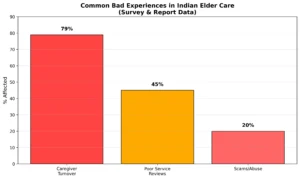
4. High Caregiver Turnover
Ask any agency directly: What is your average caregiver retention rate? How often do families experience a change in caregiver? High turnover is a symptom of deeper problems. It usually points to poor working conditions, inadequate pay, insufficient training, or weak agency management. All of those things affect the quality of care your parent receives.
Beyond the practical disruption, frequent caregiver changes are genuinely distressing for elderly parents. Trust is built slowly and carefully between a senior and the person who enters their home every day. Breaking and rebuilding that trust repeatedly takes an emotional toll that families often underestimate.
5. Vague or Inconsistent Billing
Elder care billing should be completely transparent. You should know exactly what you are paying, what each charge covers, how changes in care needs affect the cost, and what the process is for reviewing invoices. Everything should be in writing before care begins.
Agencies that quote one figure verbally and bill another, that add charges without prior discussion, or that cannot explain their invoices clearly are exhibiting financial behaviour that warrants serious caution. For NRI families managing payments from abroad, billing irregularities are both difficult to catch and difficult to resolve after the fact.
6. No Emergency Protocol
What happens if your parent falls while the caregiver is present? What if the caregiver does not show up? What if there is a medical emergency during the night? A professional care service should have clear, documented answers to all of these questions before you ask them.
If an agency cannot tell you their emergency procedure, or if their answer amounts to calling the family and waiting, that is not a protocol. It is an absence of one. In a genuine emergency, those missing minutes and missing systems matter enormously.
7. Pressure to Commit Quickly
Legitimate care services understand that choosing a caregiver for an elderly parent is a significant decision that deserves time, questions, and careful consideration. If an agency is pushing you to sign up quickly, citing limited availability, special pricing that expires soon, or any other urgency-creating tactic, step back.
Pressure selling in elder care is a warning sign. A service that is confident in its quality does not need to rush you into a decision before you have had time to think clearly.
8. No Trial Period Option
Any reputable care service should offer some form of trial arrangement, a short initial period during which your parent can experience the care, assess the caregiver, and decide whether the arrangement feels right before committing to anything longer term.
An agency that does not offer this, or that makes a trial difficult and costly, is not prioritising your parents’ comfort or fit. They are prioritising their own revenue. The best care relationships are built on genuine compatibility, and that cannot be determined in a single introductory meeting.
9. No Clear Escalation Process
If you have a concern about a caregiver, if your parent is uncomfortable, if something does not feel right, who do you call? What happens next? How quickly does the agency respond? Is there a named person who owns your account and your parents’ care?
Agencies that cannot answer these questions clearly do not have a functioning client support structure. For NRI families who depend entirely on the agency to be their eyes and ears on the ground, this is not a minor operational gap. It is a fundamental failure of the service model.
10. Caregivers Who Are Untrained for Specific Needs
Not all care needs are the same. A parent with early dementia requires a caregiver with specific skills in memory care. A parent recovering from a stroke needs someone trained in mobility support and rehabilitation assistance. A parent with diabetes needs a caregiver who understands dietary management.
Understanding these warning signs is essential when deciding how to choose elder care service India safely from abroad. If an agency places any available caregiver regardless of your parent’s specific condition, that is a mismatch that will show up in the quality of care. Ask directly: what training does this caregiver have that is relevant to my parent’s specific needs? The answer will tell you a great deal.
What a Trustworthy Elder Care Service Actually Looks Like
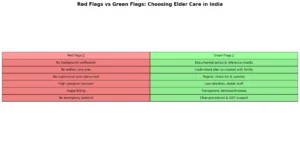
A good care service is not just the absence of these red flags. It has its own positive qualities that are worth knowing and asking for directly.
It is transparent before it asks for your trust. It shows you its verification process, its training standards, its supervision structure, and its client support model without you having to extract that information.
It centres on your parent rather than the transaction. The first conversations are about understanding your parents’ life, preferences, and personality, not just their medical needs and available budget.
It communicates proactively. You should not have to chase updates. A trustworthy service tells you what is happening before you think to ask.
It welcomes your questions. Agencies that become defensive when asked about their processes, their staff, or their track record are telling you something important about how they operate.
And it offers flexibility. Good care evolves as needs change. A service that locks you into rigid arrangements is not designed around your parents. It is designed around its own convenience.
How Samarth Vets Its Caregivers
At Samarth, we built our vetting process around a single question: would we be comfortable with this person caring for our own parent?
Every Samarth caregiver goes through documented police verification and identity checks before placement. References from previous care roles are contacted and spoken to directly. A structured interview assesses not just skills but temperament, patience, and the specific qualities that matter when working with elderly Indians in a home environment.
Training is need-specific. A caregiver placed with a parent who has Parkinson’s has different training from one placed with a parent who needs post-surgical support. We do not use a single standard profile for all care situations because no two parents are the same.
After placement, our care coordinators conduct regular check-ins with both the caregiver and the family. For NRI children, this means structured updates in plain language, a named point of contact you can reach directly, and a clear escalation process if anything needs attention.
We also offer a trial care plan as the standard starting point for every new family. Because we believe that trust is earned through experience, not promised in a sales call.
For families who have been burned by a previous provider, or who are approaching this for the first time and do not know who to trust, we welcome every question. The more you ask, the more clearly we can show you how we work.
Your Parent Deserves Better Than a Gamble
Choosing care for an ageing parent is one of the most important decisions an NRI family makes. It should not be a leap of faith into an unverified arrangement. It should be an informed choice, made with full knowledge of what you are signing up for and complete confidence in who is walking through your parent’s door.
The red flags in this blog are not meant to frighten you away from seeking help. They are meant to make sure that when you do, you choose well. Because the right care service does not just keep your parent safe. It gives you back something you may have been missing for a long time.
Peace of mind. Want to know exactly how we vet our caregivers?
At Samarth, we believe families deserve full transparency before they trust us with someone they love. Read about our caregiver verification process, training standards, and supervision model in detail.
See How We Vet Our Caregivers