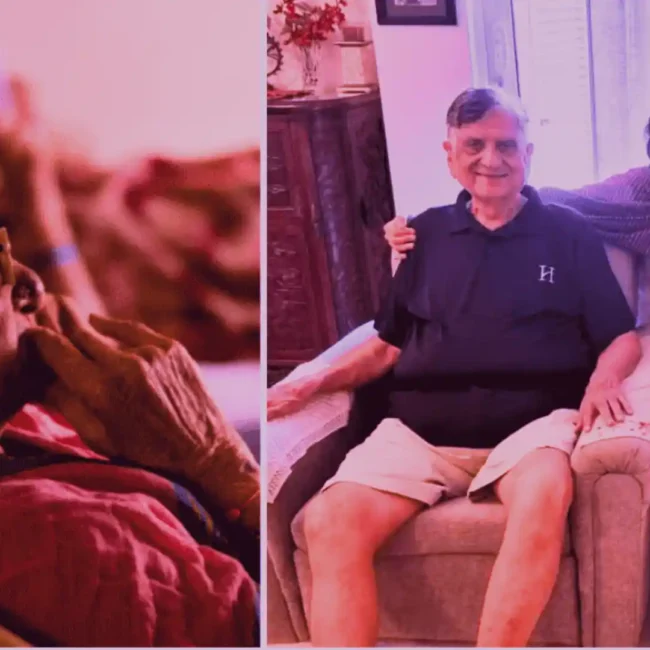
The call came on a Tuesday morning. Your father had not come down for breakfast. Your mother found him on the bedroom floor, confused, his face slightly drooping on one side, unable to lift his right arm.
By the time you landed in India, he was out of the ICU. The doctors were cautiously optimistic. The stroke had been significant but not catastrophic. With the right rehabilitation, they said, meaningful recovery was possible.
Then came the conversation you were not prepared for. He would be discharged in a week. He would need physiotherapy, speech therapy, medication management, and close monitoring. He would need someone with him for most hours of the day. He would need his home modified before he returned to it.
And you had a return flight booked for Sunday.
If you are reading this in the days or weeks after a parent’s stroke, this guide is written for exactly where you are. Not to overwhelm you with everything that could go wrong, but to give you a clear picture of what good stroke recovery at home looks like, and how to put it in place even from thousands of miles away.
Why the First 90 Days After a Stroke Are Critical
In stroke recovery, time is not just important. It is neurological currency.
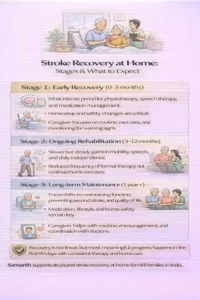
The brain has a property called neuroplasticity, its ability to rewire itself by forming new connections to compensate for damaged areas. This capacity is most active in the weeks immediately following a stroke. The rehabilitation done in the first three months after a stroke has a disproportionate impact on the level of recovery a patient ultimately achieves. What happens in this window, or what fails to happen, shapes the trajectory for everything that follows.
This is why discharge from hospital is not the end of the acute phase. It is the beginning of the most important phase. A parent returning home after a stroke without adequate rehabilitation support, without proper home setup, and without skilled care is not resting safely. They are losing ground during the period when gains are most possible.
For NRI families, understanding this urgency is the first and most important step. The decisions made in the weeks after discharge are not administrative details to be sorted when convenient. They are clinical decisions with long-term consequences.
What Stroke Recovery at Home Actually Looks Like
No two strokes are identical, and no two recoveries follow the same path. The specific deficits your parent experiences depend on which part of the brain was affected and how severely. A stroke affecting the left hemisphere typically affects speech, language, and movement on the right side of the body. A right hemisphere stroke more commonly affects spatial awareness, attention, and movement on the left side. Some strokes affect swallowing. Others affect vision. Many affect mood and cognition in ways that are less visible but equally significant.
What recovery at home looks like, in practical terms, is a structured daily environment built around rehabilitation goals. It is not rest in the way most people imagine rest. It is supported activity, repeated practice, and progressive challenge, all delivered with patience and clinical awareness.
A typical recovery day for a stroke patient at home might begin with assisted morning hygiene and dressing, which is itself a form of occupational therapy when done correctly. A physiotherapy session in the late morning works on mobility, balance, and strength. A speech therapy session, either in person or via video, addresses language and swallowing if affected. Meals are adapted to texture and positioning needs. Medication is administered on schedule. The afternoon involves gentle movement, cognitive stimulation, and rest. Evening routines are consistent and calming.
This structure is not incidental. It is therapeutic. The brain recovering from a stroke responds to repetition, routine, and progressive challenge. The quality of the daily environment is inseparable from the quality of the recovery.
Setting Up Physiotherapy at Home
Physiotherapy after a stroke is not optional. It is the primary mechanism through which function is recovered and maintained. For families managing this from abroad, setting it up correctly before discharge is far easier than trying to arrange it after the fact.
In most Indian cities, qualified physiotherapists who specialise in neurological rehabilitation and offer home visits are available. Your parents’ treating hospital should be your first point of contact. Ask the inpatient physiotherapy team for a written rehabilitation plan that outlines current functional status, specific goals for the first three months, exercises to be done daily between formal sessions, and guidance on what progress looks like at each stage.
The frequency of formal physiotherapy sessions in the early recovery period should ideally be daily or near-daily. As your parent progresses, the frequency may reduce, but the daily exercises should continue regardless.
The caregiver working with your parent must understand the physiotherapy programme well enough to support and encourage the daily exercises. This does not mean the caregiver replaces the physiotherapist. It means they do not undermine the programme by discouraging activity out of excessive caution or allowing your parent to skip exercises on difficult days. Recovery requires consistency, and the caregiver is the person who holds that consistency between formal sessions.
For families whose parents are outside major cities, telerehabilitation, physiotherapy delivered via video call, has expanded significantly and is a clinically effective option for many aspects of post-stroke rehabilitation.
Speech and Cognitive Rehabilitation
Stroke frequently affects communication and cognition, and these deficits are often the hardest for families to navigate because they change the fundamental texture of the relationship.
Aphasia, difficulty with language, affects a significant proportion of stroke survivors. It can manifest as difficulty finding words, understanding speech, reading, writing, or any combination of these. It is important to understand that aphasia is a language disorder, not a cognitive one. A parent with aphasia may have completely intact thinking and intelligence but be unable to express it. Treating them as though they have lost their mental capacity because they cannot find words is both inaccurate and deeply damaging to their recovery and their dignity.
Speech therapy is the clinical response to aphasia and should begin as early as possible after the stroke. A qualified speech and language therapist will assess the specific nature of your parent’s communication difficulty and design a targeted programme. In India, speech therapists who offer home visits are available in most major cities, and video-based sessions are increasingly common and effective.
Cognitive rehabilitation addresses the attention, memory, and executive function deficits that many stroke survivors experience. This is delivered through structured exercises, daily routines that challenge and engage the brain, and occupational therapy that works on the practical cognitive skills needed for daily life. Simple activities such as reading, card games, guided conversation, and progressively complex daily tasks all contribute to cognitive recovery when done consistently and with the right level of challenge.
The caregiver’s role in speech and cognitive rehabilitation is to create the right daily environment. Conversations that are patient, unhurried, and do not finish sentences for your parent. Activities that engage rather than simply occupy. A home that stimulates without overwhelming.
Medication and Monitoring After Stroke
Post-stroke medication management is non-negotiable and complex. Most stroke survivors are discharged on multiple medications covering blood thinners, blood pressure management, cholesterol control, and, depending on the type of stroke, other specific treatments. Missing doses, taking the wrong dose, or stopping medication without medical guidance can significantly increase the risk of a second stroke.
The caregiver must have a complete, clearly written medication schedule that includes the name of each medication, the dose, the timing, whether it should be taken with food, and the prescribing doctor’s contact details. This schedule should be reviewed and updated at every medical appointment.
Beyond medication, monitoring for warning signs of a second stroke is a critical caregiver responsibility. The FAST framework, Face drooping, Arm weakness, Speech difficulty, Time to call emergency services, should be known and understood by every person involved in your parent’s care. A second stroke in a patient who has already had one is a medical emergency. The response must be immediate.
Blood pressure monitoring at home is standard post-stroke practice. A reliable digital blood pressure monitor and a logbook recording daily readings, shared with the treating physician at each appointment, is a simple and important system.
Home Modifications for Post-Stroke Safety
A home that was safe enough before a stroke may present significant hazards afterwards, particularly if your parent has mobility limitations, weakness on one side, or balance and coordination deficits.
The priority areas are the same as in other elder care situations, but with specific stroke considerations. Grab bars in the bathroom and toilet are essential. A shower chair or bath bench removes the need to stand unsupported during bathing. A raised toilet seat reduces the effort and instability of sitting and standing.
If your parent has hemiplegia or significant weakness on one side, furniture layout should be arranged to support movement toward the stronger side. Pathways through the home must be wide enough to accommodate a walker or wheelchair if needed. Thresholds between rooms should be flush or ramped where possible.
Stair safety is a specific concern. If your parents’ bedroom is on an upper floor and they have significant mobility limitations, a temporary sleeping arrangement on the ground floor is worth considering during early recovery. If stairs must be used, a stairlift or at a minimum a solid handrail on both sides is important.
For parents with neglect, the neurological tendency to ignore one side of the environment that sometimes follows a right hemisphere stroke, environmental arrangement needs to take into account which side is being neglected and position important items, the caregiver’s approach direction, the television, and other stimuli in ways that engage rather than accommodate the neglect.
The Caregiver’s Day-to-Day Role in Stroke Recovery
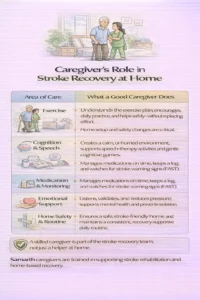
The caregiver supporting a stroke survivor is not simply assisting with daily tasks. They are, in a meaningful sense, part of the rehabilitation team.
Their role requires understanding the recovery goals and actively supporting them rather than replacing effort with assistance. When a parent can put on their own shirt with difficulty, a good stroke caregiver supports the attempt rather than doing it for them. Recovery requires effort, and the caregiver who removes every effort to make life easier is inadvertently slowing the recovery.
They need to observe and report. Changes in speech clarity, limb function, mood, swallowing, and cognition are all clinically relevant information. A caregiver who notices that your parent is slurring more than usual, or is having more difficulty swallowing, or has become significantly more withdrawn, and reports this to the family and medical team promptly, is providing a service that no remote monitoring technology can replicate.
They need to be emotionally attuned. Depression affects the majority of stroke survivors at some point in their recovery. It is not a character response. It is a neurobiological consequence of the stroke itself, compounded by the profound disruption to identity and independence that the event causes. A caregiver who can sit with your parent’s grief, who does not rush past difficult feelings, and who consistently communicates warmth and belief in their recovery is contributing to outcomes that clinical research supports.
Coordinating Stroke Recovery From Abroad
Managing a parent’s post-stroke recovery from the United States, the UK, Australia, or anywhere outside India requires a deliberate information and communication architecture. Without it, you are making decisions in the dark.
Before you leave India after the initial crisis, establish the following. A named care coordinator or primary caregiver who is your single point of contact for daily updates. A clear line of communication with the treating neurologist and any specialists involved in your parent’s care. A structured update format, daily in the immediate post-discharge period, that covers medication adherence, physiotherapy completion, notable observations, and any concerns. A protocol for what constitutes an emergency that requires you to be called immediately, regardless of time zone.
Set up a shared document or messaging group that includes the caregiver, a trusted local family member or friend, and yourself, where daily updates are logged. This creates a record that helps you track trends over time rather than evaluating each day in isolation.
Schedule a video call with your parent at a consistent time each day during the early recovery period. Keep it warm, keep it short, and keep it positive. Your emotional presence matters to their recovery in ways that are neurologically real.
Work with your employer in advance if possible, to establish the flexibility you will need during the critical first three months. This is not a personal indulgence. It is a clinical period with long-term implications.
Samarth’s Stroke Recovery Care Package
At Samarth, we understand that a stroke is not just a medical event. It is a family crisis that arrives without warning and demands immediate, high-quality decisions under the worst possible conditions.
Our stroke recovery care package is designed for exactly this situation. It begins before your parent leaves the hospital. Our care counsellors work with the treating medical team to understand the specific deficits, the rehabilitation plan, and the home care requirements before discharge. By the time your parent arrives home, the caregiver is briefed, the home has been assessed for safety modifications, the physiotherapy schedule is in place, and the medication system is ready.
Our stroke caregivers are trained specifically in neurological rehabilitation support. They understand the physiotherapy programme and how to support daily exercises correctly. They know how to communicate with a parent who has aphasia. They understand one-sided neglect and how to work with it. They know the warning signs of a second stroke and what to do if they observe them.
For NRI families, our care coordinators provide structured daily updates during the acute recovery period, transitioning to regular weekly updates as your parent stabilises. You have a named point of contact who knows your parents’ case, understands the medical picture, and can give you an honest assessment of how recovery is progressing. When something needs medical attention, we escalate it. You do not have to discover it three days later in a phone call with your parent.
We also coordinate directly with your parents’ physiotherapist, speech therapist, and neurologist, ensuring that the home care and the clinical rehabilitation are working together rather than in parallel silos.
Because stroke recovery is a team effort. And you should be leading that team with full information, even from the other side of the world.
Recovery Is Not Linear, But It Is Possible
Stroke recovery is rarely a straight line. There are good days and hard days. Some plateaus last for weeks before progress resumes. There are moments when your parent seems like themselves again, and moments when the distance between who they were and who they are now feels very large.
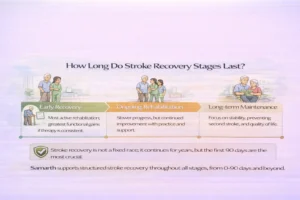
What the evidence consistently shows is that recovery continues for longer than most families are initially told. The most dramatic gains happen in the first three months, but meaningful improvement can continue for years with sustained rehabilitation, good general health management, and a care environment that supports rather than limits function.
Your parents’ brain is working to recover. Every physiotherapy session, every speech exercise, every carefully supported attempt to do something independently is contributing to that process. The care you put in place from wherever you are in the world is not peripheral to that recovery. It is central to it.
They came through the stroke. Now comes the work of coming back. And with the right support around them, more of that is possible than you might right now believe.
Your parents’ recovery starts at home. Make sure it starts right.
Samarth’s post-stroke home care package is designed for the critical first 90 days and beyond. From caregiver placement to physiotherapy coordination, medication management, and daily family updates, we handle the details so you can focus on your parent.
Set Up Post-Stroke Home Care Today