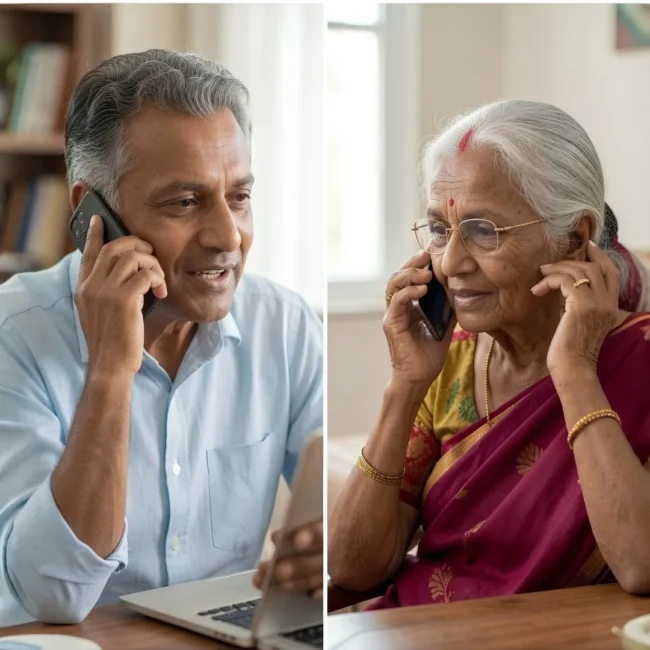
India’s top hospitals are genuinely impressive. Apollo, Fortis, Manipal, Kokilaben, Medanta, Jehangir, AIIMS — these are institutions with world-class equipment, internationally trained specialists, and clinical outcomes that compare favourably with the best hospitals in developed countries. When NRI families think about medical care for their parents back home, the reassurance is real. Good care is available in most major Indian cities.
What is less discussed is how difficult that care is to navigate.
Healthcare navigation for elderly parents in India as an NRI is not simply a matter of booking an appointment and collecting a report. The system is fragmented, specialists rarely speak to one another, and making sense of it all from the other side of the world is harder than it should be.
India’s healthcare system rewards those who know how to work it. For elderly patients navigating it alone, and for their families managing the process from abroad, the complexity is not a minor inconvenience. It is a genuine clinical risk.
The Challenge of Multi-Specialist Elderly Care in Indian Cities
Most elderly patients in India are not managing one condition. They are managing several simultaneously. A 74-year-old man in Chennai is likely seeing a cardiologist for his arrhythmia, an orthopaedic surgeon for his knee, a diabetologist for his Type 2 diabetes, and an ophthalmologist for his early-stage glaucoma. Each of these specialists may be at a different hospital. Each will prescribe medication within their domain. None of them is automatically aware of what the others have prescribed.
This is the polypharmacy problem, and it is pervasive in elderly care across Indian cities. The average elderly patient with multiple chronic conditions is managing eight to twelve medications simultaneously. The interactions between these medications are not always checked. The prescribing specialist may not have a full medication list in front of them at the time of consultation. Your parent may not remember to mention all their current medications, or may assume the doctor already has that information.
The consequences range from reduced drug efficacy to genuinely dangerous interactions. And the person best positioned to catch these problems — a coordinating physician who has oversight of the full clinical picture — is rarely part of the default arrangement.
Beyond medication, structural fragmentation creates quieter but equally consequential failures. Test results ordered by one specialist are invisible to another. Follow-up appointments are the patient’s responsibility to remember and attend. Discharge summaries rarely travel between treating doctors. The elderly patient is expected to be their own care coordinator.
When the patient is living alone, and their family is managing the situation from twelve time zones away, this system has no slack left in it at all.
What Healthcare Navigation Actually Involves
The term “healthcare navigation” is used loosely in the elder care space, so it is worth being specific about what genuine navigating healthcare in India for an elderly NRI parent actually requires.
It begins with a single, current medical record covering all diagnoses, medications, specialists, and test results. This does not exist automatically. Most elderly patients in India have a drawer full of prescription chits, discharge summaries, and hospital cards rather than anything resembling a consolidated file.
Navigation then involves appointment management: scheduling consultations, bringing the right records, preparing relevant history for the physician, and following up on referrals — all of which requires organisational competence most elderly patients simply do not have when managing alone.
It involves accompaniment: being present so the information exchange is accurate. Elderly patients frequently leave consultations with an incomplete understanding of what was said. A navigator who accompanies, takes notes, and communicates the outcome to the family provides a level of clinical safety that patient updates alone cannot.
And it involves follow-through: ensuring that the prescription is filled correctly, that the follow-up test is scheduled and attended, that the specialist’s recommendation is communicated to the other treating doctors, and that the family is informed in terms they can understand and act upon.
Diagnostic Coordination: Labs, Radiology, and Second Opinions
Managing doctor visits for elderly parents in India involves a layer that families rarely anticipate until they encounter it: the diagnostic coordination problem.
India’s diagnostic landscape is fragmented. Major chains such as Dr Lal PathLabs, SRL Diagnostics, Metropolis, and Thyrocare operate alongside hospital-based labs and a large number of independent pathology centres of varying quality. A specialist may refer your parent to the hospital’s own lab, to a preferred external centre, or leave the choice to the patient. Radiology is similarly distributed — MRI centres, CT scan facilities, and nuclear medicine units may each be at different locations.
For an elderly patient managing this independently, each diagnostic step involves a separate appointment, a potentially different location, and logistical considerations around fasting, contrast preparation, or mobility. Results are collected separately, often in hard copy, and it is the patient’s responsibility to bring them to the next consultation.
For NRI families, second opinions add another layer. Indian medical culture does not always welcome them as openly as Western systems do, and elderly patients are often reluctant to raise the subject with their treating doctor. Managing the process from abroad makes it harder still.
A navigator handles all of this: selecting the right diagnostic facility, scheduling with logistics in mind, collecting results, and ensuring they reach the relevant specialists. When a second opinion is warranted, a good navigator facilitates it without disrupting the existing care relationship.
Navigating Insurance and CGHS Claims
For many elderly patients in India, health insurance and CGHS (Central Government Health Scheme) entitlements are theoretically available but practically difficult to use. The claims process is complex, documentation requirements are exacting, and the administrative burden falls entirely on the patient or their family.
Managing parents’ healthcare in India from abroad, whilst simultaneously tracking insurance claims, introduces a specific frustration. Policies differ in coverage, empanelled hospitals, and documentation requirements. CGHS offers considerable benefits but requires navigation of its own: specific hospitals, referral requirements, and a paperwork process genuinely difficult for an elderly person without support.
Pre-authorisation must be obtained before admission. Cashless claims require the TPA desk to be engaged at the right moment. Reimbursement claims require original bills, discharge summaries, and prescriptions submitted within strict timelines. Missing any step risks rejection.
A healthcare navigator who understands your parents’ insurance landscape can manage this process on their behalf, reducing administrative burden and avoiding avoidable claim rejections.
How to Stay Informed from Abroad Without Overwhelming Your Parents
One of the more nuanced challenges of managing your parents’ healthcare from abroad is calibrating your involvement so that it is genuinely helpful rather than anxiety-driven.
Asking your parent to report back after every appointment rarely produces useful information. They will tell you it went well. They will remember the most reassuring thing the doctor said and forget the most important. They will not mention that they did not understand the dosage instructions, or that they never asked the question they had planned to because the doctor seemed busy.
A structured information system works considerably better: a named coordinator who attends appointments and provides accurate summaries, a shared digital folder where results and discharge summaries are uploaded as they are issued, and a monthly health consolidation you can read in ten minutes and discuss on a scheduled call.
The goal is to be meaningfully informed without turning every call with your parent into a health interrogation. Good healthcare coordination separates the clinical management channel from the personal relationship, which benefits both.
Samarth’s Healthcare Coordination Model
Samarth’s approach to healthcare navigation for elderly parents across Indian cities is built around continuity of oversight rather than episodic intervention.
Every enrolled parent has a maintained medical profile: current diagnoses, active medications, treating specialists, designated hospitals, insurance details, and documented medical history. Updated after every consultation or procedure, it is accessible to the Samarth coordinator at any time and shared with the family in a format they can actually use.
When a consultation is scheduled, the coordinator prepares a brief covering recent history, current medications, and questions the family has asked to be raised. They accompany the parent, take structured notes, and provide a clear summary within 24 hours. Prescription changes are flagged immediately. Follow-up appointments are scheduled before the family needs to ask.
Diagnostic coordination is managed end-to-end. The right facility is selected, results are collected and uploaded to a shared folder, and the relevant specialist is informed. Insurance and CGHS paperwork is handled by the coordinator without the family needing to chase it.
The Samarth model assigns the coordination responsibility to a professional with the relationships, medical literacy, and local presence to carry it effectively.
Let Samarth Navigate Your Parents’ Healthcare
The families who feel most in control of their parents’ health situation in India are not the ones who call most frequently or worry most intensely. They are the ones who have a system in place: accurate records, a trusted coordinator on the ground, structured updates, and the confidence that when something changes clinically, they will be informed promptly and clearly.
Samarth works with NRI families across India’s major cities to provide exactly that system. If your parent is managing multiple conditions, multiple specialists, or simply the ordinary complexity of ageing in a fragmented healthcare environment, a Samarth healthcare coordinator can take the navigation burden off both of you.
You should not have to piece together your parents’ medical picture from WhatsApp photographs of prescription chits. You should not be reading discharge summaries at midnight, trying to understand what happened and what comes next. That clarity is available. It simply requires the right support structure.