Your mother called you by your uncle’s name last Tuesday. You laughed it off on the call, told her it was fine, and changed the subject. But after you hung up, you sat with it for a long time.
It was not the first time. There was the incident with the stove two months ago. In the afternoon, she could not remember whether she had eaten lunch. The way she sometimes pauses mid-sentence, searching for a word that used to come easily, looking briefly lost in a way that passes quickly but leaves something behind.
Nobody has said the word yet. Not the doctor, not your father, not you. But you have been reading late at night, and the word keeps appearing. And you are trying to understand what it means for a parent who is ten thousand miles away, living in a home that was not designed for this, with a family that loves her but does not know what is coming.
This guide is written for that moment. For the time between suspicion and certainty, and for everything that follows.
Understanding Dementia Before You Can Care for It
Dementia is not a single disease. It is an umbrella term for a group of conditions characterised by progressive decline in memory, thinking, behaviour, and the ability to perform everyday tasks. Alzheimer’s disease is the most common form, accounting for the majority of dementia cases. Vascular dementia, Lewy body dementia, and frontotemporal dementia are among the others, each with their own pattern of progression and care demands.
In India, dementia remains significantly underdiagnosed. Many families attribute early symptoms to normal ageing, stress, or vitamin deficiencies. By the time a formal diagnosis is made, the condition has often been present and progressing for years. For NRI families piecing together a picture from phone calls and short visits, this diagnostic gap can mean that the reality of where a parent actually is in their progression comes as a shock.
Understanding dementia as a progressive neurological condition, rather than a personality change or a consequence of old age, is the foundation of good care. It changes what you expect, what you ask of caregivers, and how you respond when something difficult happens.
Early vs Late Stage: How Care Needs Change
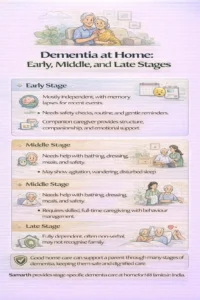
Dementia progresses across a spectrum, and the care a parent needs at one stage looks very different from what they need at another. Most clinicians describe the progression in three broad phases, though in practice the transitions are gradual and uneven.
In the early stage, your parent is largely independent but beginning to show consistent memory lapses, particularly for recent events and new information. They may repeat questions, lose track of time, misplace objects, and struggle with complex tasks like managing finances or planning. They are often aware that something is changing, which can make this stage particularly emotionally difficult. Care at this point is primarily about safety monitoring, routine reinforcement, and emotional support. A companion caregiver who provides structure and gentle reminders is often the right fit.
In the middle stage, memory loss becomes more pronounced and begins to affect daily functioning significantly. Your parent may forget the names of close family members, become confused about where they are, and need assistance with bathing, dressing, and meals. Behavioural changes are common at this stage, including agitation, suspicion, repetitive behaviours, and disturbed sleep. The caregiver’s role becomes more hands-on and more skilled. Managing behaviour with patience rather than correction becomes essential. Supervision can no longer be intermittent.
In the late stage, your parent requires full-time care. They may be largely non-verbal, unable to recognise family members, and dependent on caregivers for all basic functions, including eating and personal hygiene. Comfort, dignity, and pain management become the primary goals of care. This stage places the greatest demands on caregivers and the greatest emotional weight on families.
Knowing where your parent currently sits in this progression is not about bracing for the worst. It is about making sure the care they have now is matched to what they actually need.
Safety Risks at Home and How to Address Them
For a parent with dementia, the home environment becomes both a source of safety and a source of risk, often simultaneously. The same familiar kitchen that orients them can also present genuine hazards if the right precautions are not in place.
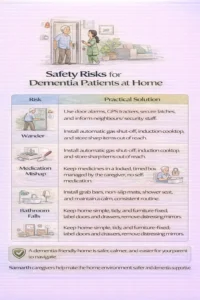
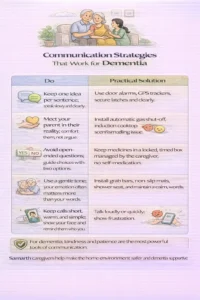
Wandering is one of the most serious risks associated with dementia, particularly in the middle stages. A parent who leaves the home alone, disoriented, and without awareness of the danger can become lost quickly and be unable to communicate who they are or where they live. Door alarms, GPS tracker devices designed for elderly adults, and secure latches placed at heights that are not intuitive to someone with cognitive impairment are all practical safeguards. Neighbours and building security staff should be informed and asked to alert the caregiver if your parent is seen leaving unaccompanied.
The kitchen presents specific risks around gas, sharp implements, and the potential for burns. An automatic gas shut-off device is a worthwhile investment. Knives and other sharp items should be stored out of easy reach. Induction cooking eliminates open flame and is worth considering as the condition progresses.
Medication safety is critical. A parent with dementia cannot reliably self-manage their medication. Doses may be forgotten, doubled, or refused. A locked medication box with timed release, managed by the caregiver, removes this risk. The caregiver must understand every medication, its purpose, its schedule, and what a missed or doubled dose looks like in terms of observable effects.
Bathroom safety follows the same principles as other elder care situations, but with the additional consideration that a parent with dementia may resist help with personal hygiene. Grab bars, non-slip mats, a shower seat, and a consistent bathing routine that the parent has come to expect all reduce both physical and behavioural risk.
Clutter and visual complexity increase confusion and anxiety in dementia patients. A clean, consistent, simply arranged home is genuinely easier for a dementia-affected brain to navigate. Remove mirrors in spaces where your parent becomes distressed by their reflection, a surprisingly common occurrence in mid to late-stage dementia. Keep furniture arrangement consistent. Label rooms and drawers clearly.
Communication Strategies That Actually Work
One of the most painful and most misunderstood aspects of dementia care is communication. Families who try to reason with a parent about what is real, correct their memory, or argue against a confused belief find that it makes things worse, not better. This is not a failure of persuasion. It is a neurological reality.
The brain of a person with dementia is not processing reality in the way it once did. Insisting on that reality does not restore their grip on it. It creates conflict, distress, and a deterioration in the relationship that serves no one.
What works instead is meeting your parent in their reality rather than pulling them into yours. If your mother believes it is 1987 and she needs to pick up her children from school, arguing that it is not 1987 and her children are grown will distress her. Acknowledging her feelings, redirecting her attention, and moving gently to another subject preserves the interaction and her dignity.
Speak slowly and simply. Use short sentences with one piece of information at a time. Ask questions that require yes or no rather than open recall. Use your parent’s name to begin a sentence when you need their attention. Approach from the front and at eye level. Maintain a calm, warm tone regardless of the content, because your parent will respond to your emotional register long after they have lost the ability to track your words.
For NRI children on video calls, these principles matter enormously. The call itself can be disorienting. Keep it short, warm, and simple. Show your face clearly. Remind them who you are if needed, without embarrassment. A two-minute call that leaves your parent feeling loved and calm is more valuable than a twenty-minute call that ends in confusion and distress.
What a Good Dementia Caregiver Does Differently
General elder care experience is not sufficient for dementia care. The condition demands a specific combination of knowledge, skill, and temperament that not every caregiver possesses.
A good dementia caregiver does not correct or argue. They have internalised the communication principles described above and apply them consistently, even when it is counterintuitive. They understand that the behaviour they are managing, the repetition, the confusion, the occasional aggression, is not personal and not deliberate. It is neurological. Their response is always calibrated to that understanding.
They are observers. They notice changes in your parents’ behaviour, sleep, appetite, and mood and understand that these changes often signal something, whether a medication issue, an underlying infection, an emotional need, or a progression in the condition. Urinary tract infections, for example, cause sudden and dramatic cognitive decline in elderly dementia patients and are frequently mistaken for disease progression. A skilled caregiver notices the change and escalates it to a medical professional rather than absorbing it as a new normal.
They provide structure without rigidity. A consistent daily routine is genuinely therapeutic for dementia patients. Predictability reduces anxiety and supports functioning. A good caregiver builds and maintains that structure while remaining flexible enough to follow the patient’s lead on any given day.
They protect dignity in every interaction. Bathing, toileting, and dressing a person who was, until recently, fully independent requires a particular kind of care and sensitivity. How this is done matters as much as whether it is done.
Managing Dementia Care From Abroad
For NRI families, dementia care presents a specific set of challenges that go beyond the practical. There is the grief of watching a parent change through a screen. There is the guilt of not being there. There is the complexity of making medical decisions from a distance, often without full information and sometimes under pressure.
There are things you can do that make a meaningful difference from abroad.
Establish a reliable information system. You should be receiving regular structured updates from the caregiver or care coordinator, covering your parent’s daily functioning, any behavioural changes, medication adherence, and notable incidents. This is not a luxury. It is the minimum you need to make good decisions.
Build a local support network. A trusted relative, a neighbour, a family friend who can visit occasionally and give you an honest ground-level view is invaluable. This person is not a substitute for professional care but an additional layer of visibility and connection.
Stay connected to the medical team. The treating neurologist should have your contact details and know that you are the primary decision-maker or a key participant in care decisions. Ask for reports after each appointment, and do not rely solely on your parent or their caregiver to relay medical information accurately.
Take your own emotional needs seriously. Caring for a parent with dementia from a distance is a form of grief that begins before loss and continues throughout. Speaking to a counsellor, connecting with NRI caregiver support communities, or even simply naming what you are carrying to people who understand it matters for your own sustainability as a long-distance caregiver.
When Home Care Is No Longer Enough
This is the question most families are afraid to ask, and the one that deserves an honest answer.
For many dementia patients, good home care can support quality of life through much of the disease’s progression. With the right caregiver, the right environment, and the right medical support, home remains the best place for a parent to be for longer than many families expect.
But there are circumstances where home care reaches its limits. When a parent requires around-the-clock supervision that a single caregiver cannot safely provide. When behavioural symptoms become severe enough to create a genuine risk to the patient or the caregiver. When medical needs become too complex for a home setting. When the primary family caregiver, often a spouse, is themselves elderly and no longer able to contribute to the care environment.
These situations do not represent failure. They represent a condition that has progressed to a point where a different level of care is what love looks like. Memory care facilities in India vary enormously in quality, and choosing one deserves the same rigorous vetting as choosing a home care service. But the conversation about when that transition might be needed is worth beginning before the situation becomes a crisis.
Samarth’s Approach to Dementia Care
At Samarth, we approach dementia care with the understanding that this condition asks more of a caregiver than almost any other. It asks for knowledge, patience, emotional resilience, and a genuine commitment to the dignity of the person in their care, regardless of what the disease takes from them.
Our dementia caregivers receive condition-specific training that covers the neuroscience of dementia in accessible terms, stage-specific care approaches, communication strategies, behaviour management, safety protocols, and the emotional dimensions of working with a patient whose relationship with reality is changing. Training is not a one-time event. It is reinforced through supervision, case reviews, and ongoing support from our care coordination team.
We match caregivers to dementia patients based on personality and temperament as carefully as we match on skills. A calm, unhurried, naturally warm caregiver working with a patient who is anxious and easily agitated is not an accident. It is a deliberate decision made with knowledge of both people.
For NRI families, our care coordinators serve as your consistent point of contact, your eyes and ears on the ground, and your bridge to the medical team. You receive structured updates that give you a real picture of your parents’ daily life, not a sanitised summary. When something changes, you hear about it from us before you have to ask.
We also understand that dementia care is not only about the patient. It is about the family living with the weight of a condition that asks difficult questions and does not offer easy answers. We hold space for that, and we walk alongside you through every stage.
Your Parent Is Still Themselves
Dementia changes a great deal. It takes memory, language, recognition, and independence. But it does not take personhood. Your parent is still themselves, underneath and alongside everything the disease does. They still feel love, comfort, safety, and dignity, even when they can no longer name those feelings or the people who offer them.
The care you put in place for them, from wherever you are in the world, is how that love shows up in their daily life. It is the warm face that greets them each morning. The familiar routine that makes their day feel navigable. The caregiver who sees them fully and treats them accordingly.
You cannot stop the progression. But you can shape the experience of it. And that, for a parent who can no longer fully understand what you are doing or why, is everything.
Navigating dementia care from abroad is hard. You do not have to do it alone.
Samarth’s dementia care specialists can help you understand where your parent is in their progression, what care they need now, and how to plan for what comes next. No obligation. Just clarity.
Speak to a Dementia Care Specialist